Social Media

Honey, black cherry and almond cake {gluten free}

13 June 2017

Every year I write about my love for stone fruits. Peaches, cherries, apricots and plums are my absolute favourite to eat and to bake with. Juices dripping down wrists as we messily ate these as children remain the epitome of summer to me. The summery, light and floral notes of a perfectly ripe peach have excited writers and lyricists for hundreds of years - and who am I to disagree with such an amorous heritage? 

Cherries can often be hit and miss, especially as so many of them are commercially grown every summer. A truly delicious cherry - heady, sharp and deep in colour - is something to be cherished. This cake, rich with honey and toasty almonds, was my answer to that challenge. A modern version (I hope!) of the traditional Bakewell. 
 THE INGREDIENTS
6 eggs
75g runny honey
75g light brown sugar
200g ground almonds
60g buckwheat flour
1 tsp baking powder
1/2 tsp fine salt
2 tsp vanilla extract
150g butter, melted
150g cherries, stoned and halved
75g flaked almonds

THE RECIPE
Heat the oven to 160°C and line a 9" cake tin with baking parchment. 

Separate the eggs, and place the whites in a large, clean bowl. Whisk the whites into soft peaks.

While the whites are whisking, weigh the honey, light brown sugar, ground almonds, buckwheat flour, baking powder, salt and vanilla extract into a separate bowl. Whisk to combine. Add the egg yolks and melted butter, and mix until well combined.

Add one large spoon of the whites to the second mixture. Beat in to loosen the mixture. Next, add the remaining egg whites and carefully fold until combined, working to retain as much air as possible. Transfer the mixture to the prepared tin.

Stone and half the cherries, and arrange on top of the cake. Sprinkle over the flaked almonds. Place in the oven and bake for 25-30 minutes. Test the cake and, if not completely baked, cook for a further 10-15 minutes. 

Remove from the oven and allow to cool completely. Serve with lightly whipped cream and an extra drizzle of honey.

Pin ThisShare on Tumblr

Yoghurt, oatmeal and fig breakfast muffins

25 October 2016

The pursuit of a healthier diet has, for many years, languished at the murky, ink-splattered bedrock of my mental to-do list. 

Along with finding the perfect red lipstick and finishing The Female Eunuch , I refuse to write it off in the secret hope that one day, inspiration will seize me and I’ll wake up as Gwyneth Paltow.

Blessed as I am with a vocation that requires me to eat cake each day, the GOOP lifestyle is likely to remain out of reach for a while longer. Mockery aside, we'd have to have been hiding under a rock to have missed the revelation that breakfast is the foundation to it being, in Gwyneth's own words ‘all good’. If it’s true that breakfast is the most important meal of the day, I might be in some trouble.

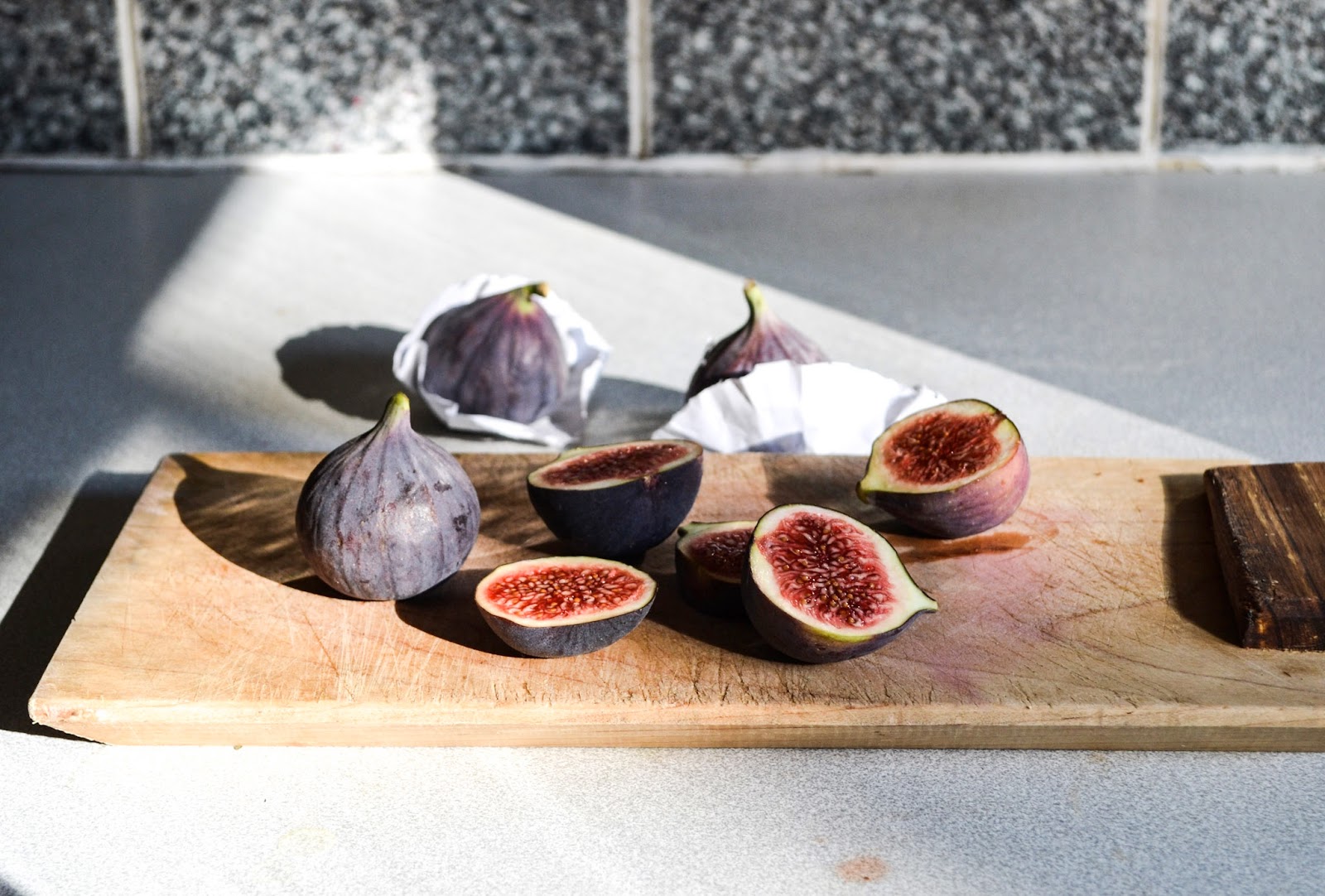
And so a recipe for breakfast on the go. These muffins are so quick to throw together - and throwing together this truly is - and will last all week, packed as they are with fresh figs to keep them moist and delicious. They're also made using oatmeal, yoghurt and fruit, which totally justify the whole cake-for-breakfast concept. 

THE INGREDIENTS
50g unsalted butter
50g muscavado sugar
1 egg
175g natural yoghurt
100g oatmeal 
35g plain flour
1/2 tsp baking powder
1/2 tsp bicarbonate of soda
1/2 tsp salt
7-8 small figs 
2-3 tbsp honey
9 sprigs thyme (optional)

THE RECIPE
Heat your oven to 180°C / 160°C fan, and line a muffin tin with 9 muffin cases.

Melt the butter, then whisk with the muscavado sugar in a large bowl. Beat in the egg and the yoghurt. In a separate bowl, whisk together the oatmeal, plain flour, baking powder, bicarbonate of soda and the salt. Whisk the dry ingredients into the wet, until the two are just incorporated. Divide the mixture among the cases. 

Clean and trim the figs, then cut 5 of them in half. Push a half a fig into each muffin. Slice the remaining figs, and place a slice or two on top of each muffin. Drizzle them with honey, and top with a sprig of thyme (if using). Bake in the centre of the oven for 20-25 minutes. 

Pin ThisShare on Tumblr

HONEY AND HIBISCUS POACHED PLUMS

24 August 2016

As summer draws to a balmy close, so does the stone-fruit season. British plums are the late bloomer of the family, and flourish through late August and September. From greengage to Victoria to tiny mirabelles, plums have a complex and fragrant flavour which is delicious to bake with.

Perfectly ripe fruits need little adornment, which is why I love to poach them gently in a simple syrup spiced with rich hibiscus. The deep hues of these tropical flowers make for a deep red poaching syrup, and brings out the gentle tang of the fruit. Aromatic honey brings a warm depth to this subtle dessert.

It's best to pick plums which are slightly firm for this recipe, to ensure they hold their shape when poaching. Serve warm with creamy mascarpone.

THE INGREDIENTS
300g plums
170g runny honey
350g water
1 vanilla pod
3-4 dried hibiscus flowers
1 cinnamon stick
1 star anise

THE RECIPE
Half the plums, and remove the stones. Set aside.

In a deep saucepan, weigh out the honey and the water. Stir to combine. Split the vanilla pod, then add to the saucepan along with the hibiscus flowers, cinnamon stick and star anise. 

Set over a medium heat, then add the plums and stir. Reduce the temperature to a simmer, and poach for 15-20 minutes, until the plums are soft and the syrup has reduced and thickened. 

Remove the cinnamon stick, star anise and hibiscus flowers, and serve warm with mascarpone.


Pin ThisShare on Tumblr

SUNKEN HONEY PEAR CAKE

13 February 2016

 I am often asked whether I eat everything that I bake. It's a question that continues to amuse me, and I remain undecided as to whether I should be offended or deeply flattered by the suggestion that I physically ingest several large cakes by myself on a weekly basis. Ego massaging aside, it's a question that should come as no surprise: we as readers crave resolve to a story, and love few things more that the reassurance that our protagonists (whether they be human or food stuff) will live happily ever after.

Free to a good home, my cut-into creations tend to take their leave with friends, family, boyfriend and on occasion, the sweet lady who lives downstairs and was really very understanding that time our boiler leaked and her ceiling fell in.

While I adore the abundance and indulgence that characterise baking, the propensity for waste continues to trouble me. Consistent recipe development, testing and tweaking results in a lot of baked goods, and it can be tempting - crazy as this may sound - to chuck anything in the bin that isn't quite perfect. I have to remind myself that baked goods, perfect or not, should be enjoyed and treasured. Otherwise, what is the point in all of this?

And I'll admit - I give things away because it's lovely, but also because I know my willpower is only so strong, and that one day I will succumb to my much-nurtured fantasy of eating chocolate souffle in the bath. It's a beautiful image, but one that I'm not quite ready for just yet.

Were I to be caught on at a weak moment, however, this sunken pear and honey cake would go rather well with the large glass of Prosecco, scented candles and whale sounds that populate the aforementioned fantasy. Drizzle with extra honey or reduced poaching syrup if you're planning a particularly long soak.
 THE INGREDIENTS
2 poached pears (recipe here)
125g butter
75g soft light brown sugar
50g clear honey
2 eggs
50g ground almonds
75g wholewheat flour, plus extra for dusting
1 tsp baking powder

THE RECIPE
Poach the pears according to the recipe. Preheat your oven to 180C fan, and line a small loaf tin with baking parchment. Lay the pear halves onto kitchen paper to dry them out ahead of baking.

For the cake, cream together the butter and sugar until light and fluffy, then drizzle in the honey with the mixer running. Add the eggs one at a time, beating to combine before each additional. Sieve in the almonds, flour and baking powder, and fold into the mixture. Pour into the prepared tin, and level the surface with a palette knife. 

Dust the rounded side of each pear half with flour, leaving the flat side clean. Gently arrange on top of the cake. Try not to push them down while you arrange them, as you don't want them to sink beneath the batter in the oven. 

Bake for 25-30 minutes, until the surface is risen around the pears, golden, and a knife comes out clean from the centre of the cake.

Pin ThisShare on Tumblr

BAKED PEACHES WITH LEMON VERBENA CREAM

18 October 2015

Earlier this month I was lucky enough have three of my recipes published with The Telegraph, in a feature I wrote on how to bake with tea.

Tea is one of my favourite baking ingredients. It's versatility, both in terms of blends and substance, is perfect for baking, and the aromatic punch of fresh and dried leaves alike can elevate baked goods to new heights of flavour and complexity.You can read my advice on how to bake the best out of your brew here.

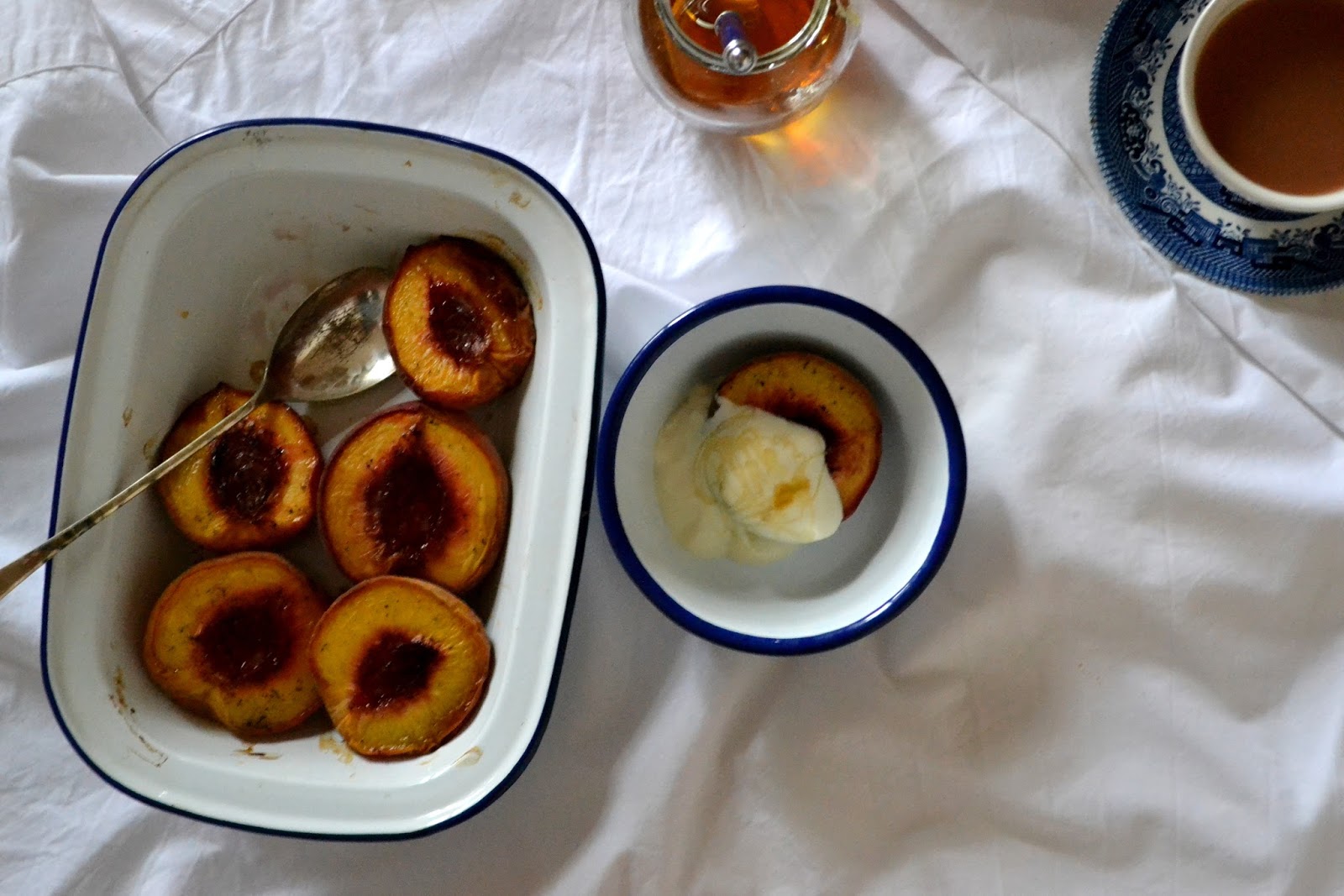
Lemon Verbena is not strictly a tea of course, but the dried blend of this fabulous herb has a light, subtle tang which adds a new depth of flavour to fresh, thick whipped cream. While this recipe calls for peaches, this fragrant verbena cream would also sit beautifully alongside figs, pears or plums.

My recipe for baked peaches with lemon verbena cream is available on The Telegraph lifestyle here.

Pin ThisShare on Tumblr

HONEY ROSE FRIANDS

6 June 2015

 
This week, I found myself phoneless for a few days and, I am ashamed to admit, experienced the damning realisation that I am hook, line and sinker dependent on my iPhone. I went 24 hours - yes, just one day - without a phone, and the stress levels experienced were nothing short of embarrassing.

Having given up the ghost one evening this week, my poor phone sat on my dressing table as I vaguely suggested that I'd take it to the Apple store. My initial nonchalance quickly dispersed as I went to set my alarm... on my iPhone. Cue a 5.45am wake up call by my lovely and very gracious flatmate who was heading out for her café shift.

Despite my early start, I realised with a cloud of utter panic that my carefully laid plans to meet my friend to catch a train together relied on WhatsApp. Several desperate Facebook messages later, a plan B was in place.

Bag packed to go, I go to check the weather... on my phone. Oh right. No bother - it doesn't look like rain. Cue an absolute soaking en route to the tube. I arrive at my tube station to a foray of announcements about emergency works and, the absolute worst, rail replacement bus services. This line is closed - how have I missed this? Shoot, because my daily TFL updates are going to an inbox I can't access.

It's fine, I say to myself, totally fine. I'll just check the best way to get to Kings Cross without this line. *Reaches for iPhone, nearly cries.*

I could go on, but it's boring for you and embarrassing for me, so I'll save everyone the discomfort. 24 hours of smartphone-sobriety was undoubtedly stressful, but also really illuminating. How is it that I, a professional 23 year old woman, can't cope without the little computer I carry around in my pocket? Have I lost the ability to think through problems by myself?

Perhaps the answer to this question is, well, yes. It's a scary thought, by it's certainly made me take stock of my relationship with my phone, and the technology that surrounds me more broadly. There are so many surveys and reports revealing that we spend too much time on our phones, but it was my own digital detox (if you will) that's brought this home to me.

We're so busy checking in on everyone's lives, and it's easy to forget to step back, take stock and unwind without a screen beneath our noses. I made these honey and rose friands to calm myself during the phone crisis. I'm not necessarily suggesting you do the same, but I do think you should make them, and not just because they're delicious. Make them because you'll feel calm, and the people you care about will love you. And, you know, they might make a pretty Instagram picture.
 THE INGREDIENTS
125g butter
125g ground almonds
5 egg whites
100g flour
1/2 tsp baking powder
125g icing sugar
2 tbsp. honey
glaze
100g icing sugar
1 tsp rose water
rose petals
 
THE RECIPE

Preheat your oven to 160C, and melt the butter. Using a pastry brush, use a little of the butter to grease your friend moulds. Set the remaining butter aside.
 
Measure the egg whites into a large bowl, and whisk a little until frothy but not yet in soft peaks. Add the ground almonds, flour, baking powder, icing sugar and honey, and fold to combine. Add the melted butter, beat, then leave to rest for 30 minutes.
 
Once rested, measure into your buttered moulds. Bake for 15-20 minutes, until pale but cooked and springy to the touch. Allow to cool for a few minutes, then remove to a wire rack and allow to cool completely.
 
For the glaze, combine the icing sugar and rose water and, if needed, add an additional teaspoon or two of water to loosen. Drizzle over the cooled friands, and decorate with dried rose petals.
  

Pin ThisShare on Tumblr

HONEY AND CRANBERRY NOUGAT

13 December 2014

Christmas can be an expensive time of year, especially if you have a big family (blood or urban) to buy for. Every year I put off the Christmas shop, and every year I seem to find myself hurling from shop to shop on Christmas Eve, battling past the world and his dog and whoring out my poor credit card as if money is going out of fashion.

This year, I had a stern word with myself. Lucy, you are 23 now and need to start behaving like the serene and graceful lady you aspire to be. With a bit of forward planning, it's so easy to make Christmas presents that will show your nearest and dearest just how much you love them.

Having made my own hot chocolate sticks last year, I needed something new and delicious to rustle up. Nougat is beautifully Christmassy, economical to make and keeps well for several weeks - which comes in handy in the post-Christmas glut.

So when Daelmans Stroopwafels got in touch asking me to share my favourite Christmas coffee-time treat, I couldn't think of a better recipe to post. Nougat should be soft, chewy, nutty and fruity, and that's exactly what this is.

While we're on the subject - Stroopwafels are possibly the best biscuits I have ever eaten - and I am no novice when it comes to biscuit consumption. Gone are the days of the dunker. Rest one of these little beauties atop your steaming cup of coffee (virgin or Irish, it is Christmas after all), give the heat of your drink a few minutes to soften the gooey caramel within, and prepare to be totally won over. The tins are kind of my favourite thing ever, too. If anyone is looking for something to buy me for Christmas... consider that a hint. 
I digress. For my nougat, I used hazelnuts and cranberries, but you can use whatever fillings you like. This recipe is really quite simple, but does require a little bit of planning and multi-tasking. You'll also need a sugar thermometer - they're really inexpensive and so useful, so I'd recommend investing if you're not using one already.

I'd love to hear what you're baking this Christmas - as always, you can contact me on Facebook, Twitter and Instagram.
THE INGREDIENTS 
50g cornflour
50g icing sugar
210g caster sugar
250g honey
400ml water
2 egg whites
100g hazelnuts
100g dried cranberries

THE RECIPE
Begin by mixing the cornflour and icing sugar together in a small bowl. Next, line an 8" baking dish with parchment, then dust with half of the icing sugar mixture. Set the rest aside. 

Now is the time for forward planning - don't be tempted to skip this stage. Measure the caster sugar and water into a large saucepan and place on your most powerful hob. Measure the honey into a small saucepan, and place on a second hob. Break the egg whites into the bowl of a free-standing mixer. 

Heat the caster sugar mix on a high heat, using the sugar thermometer to monitor the temperature. Once it reaches 118C, turn the heat down and move the thermometer to the honey saucepan. Bring the honey to the boil, and start beating the egg whites until the form still peaks. Keep your eye on the honey as it heats very quickly. Once it reaches 130C, remove from the heat and steadily pour into the egg whites with the mixer beating. Reduce the speed, and keep it going.

Move the thermometer back into the sugar mixture, which should have been gently bubbling while you dealt with the honey. Raise the heat to high, and when the mixture reaches 150C, add it to the egg mixture in a steady stream. Beat on high for 5 minutes, until the mixture is pale, thick and glossy.

Use a metal spoon to mix in the nuts and cranberries, then scrape the mixture into the prepared tin. Press it into an even layer (it will be sticky!) then top with the remaining icing sugar mixture. Transfer to the fridge to firm up over night.

Using a heated knife, slice the nougat into individual pieces. If you're giving the nougat as a gift, wrap the pieces with baking parchment, and fasten with string. Package up in a box, fasten with ribbon, and prepare your modest expression when everyone is raving about them.

Pin ThisShare on Tumblr

MILK, HONEY AND LAVENDER BREAD

12 August 2014

Jerusalem the golden, with milk and honey blessed

Today I felt the first rustle and gust of autumn. After a scorching few weekends of barbeques and festivals, I'd almost forgotten that our Indian summer won't last forever.

I can't help but love the nostalgia that a truly British autumn brings. 22 I may be, but I still get that back-to-school feeling in my tummy, and secretly look forward to unearthing forgotten coats and thick, friendly knitwear from the back of the cupboards. Perhaps i'm getting a little ahead of myself - it's only the 12th of August after all. Perhaps i'm still feeling the effects of a long weekend at Wilderness Festival. But either way, indulge me just the once.

This recipe reminds me of a hymn which will forever pull on my heartstrings and have me donning my rosy-tinted glasses for the autumn term at school. While i've certainly carried my passion for new stationary into my adult life, the hymn-singing that seemed so tedious in those day is now firmly embedding in my past. I look back on it with such fondness, and can't help wishing i'd appreciated those days more.

Just as the milk and honey remind me of chanting Jerusalem at school, the lavender in this recipe comes straight (figuratively, at least) from my Mum's garden. This recipe yields two mini loaves, or one big bundle of nostalgic, sticky-sweet love.

THE INGREDIENTS
500g strong white bread flour
10g fast action yeast
10g fine salt
50g honey
40g butter
2 eggs
230ml milk
small bunch of lavender
for the glaze
1-2 heads of fresh lavender
1 tbsp runny honey
1/2 tbsp hot water

THE RECIPE
Begin by measuring your milk into a small saucepan. Add the lavender heads, then heat over a low heat until the milk is just bubbling. Immediately turn the heat down, then leave it to infuse and cool to lukewarm temperature. Strain through a fine sieve, and set aside. 

Weigh the flour straight into a large mixing bowl, then add the salt and honey to one side, and the yeast to the other. Pop the butter in the middle and crack in the eggs, then pour in 3/4 of the lavender infused milk. Using a scrunching motion, bring the mixture together with your hand. If needed, add the remaining milk - the dough should be sticky at first, then become smooth as you continue to work it. Once the dough has picked up all the mixture from the bowl, tip it out onto an oiled work surface, and knead for a further 10 minutes. The dough is ready when it's stretchy and supple, and you can see the strands of gluten when you pull it thin (this is called 'window-paning').

Pop the dough into a large oiled bowl, cover with cling film, and leave to rise for around an hour. Once the dough has doubled in size, tip it back onto the work surface, and knock all of the air out by folding it in on itself repeatedly. Split the dough into two, and shape each into a sausage shape. Pop into two small loaf tins, then enclose each tin in a clean plastic bag, and leave it to rise for a further hour. Once the loaves have doubled again, preheat your oven to 220C. Bake in the preheated oven for 15-25 minutes - you will be able to tell that they are baked when you knock the bottom and hear a hollow sound.

To make the glaze, pull the buds from the lavender spring, and mix with the honey and hot water. Brush over the loaves while they're still hot from the oven. 

Laced with rich milk and honey, these golden beauties certainly taste like they've come from somewhere special. Delicious with creamy British butter.

Pin ThisShare on Tumblr
 

PUDDING LANE© Theme by Blog Milk